Rewiring Habits: Shifting Indonesia from a Nation of Spenders to Savers
Rewiring Habits: Shifting Indonesia from a Nation of Spenders to Savers
Problem: Due to regulatory limits, GoPay couldn’t lend wallet balances, so Jago Pockets was launched with Bank Jago as a savings workaround, offering interest and free transfers. But with a 16-step onboarding, unclear benefits, and liquidity concerns, adoption stayed low: just 21% conversion and 60% drop-off at the first screen.
Solution: We redesigned it as GoPay Tabungan, a wallet upgrade with 1-click onboarding for existing Jago users and 5-click for new ones. Clear benefit comparisons, visible liquidity, and Sharia-compliant flows made the experience seamless for users—and unlocked lending potential for the business.
Company
Gojek
DELIVERABLES
Onboarding Optimization
Journey Design
Adoption Strategy
Year
2023
2024
Role
End-to-end product design
1.6 Million Accounts but out of 38 million, Still Not Enough

GoPay Wallet was a daily essential in Indonesia, but since it was just a wallet, users couldn’t earn interest, and GoTo couldn’t lend the money stored in it.
To fix this, we launched Jago Pockets (Jago bank account) registration inside the Gojek app in 2021.
Result: 1.6 million users opened bank accounts through the GoPay–Jago flow.
But even with strong marketing and product efforts, major drop-offs remained.
💼 As a Product Designer, I:
Led the re-architecture from Jago Pockets to GoPay Tabungan
Directed all research + post-MVP UT
Collaborated across PM, legal, Bank Jago, engineers
Shaped inclusive onboarding for Sharia and conventional segments
❌ Why the Original Flow Struggled
Based on quantitative funnel data:
Low conversion (~21%)
The Jago Pockets onboarding required 16 steps, including multiple forms, KYC redundancies, and mental effort. Users dropped off midway.
Weak value proposition
60% drop-off on the first screen itself signaled users didn’t understand why they should open “another account.”
Unclear money fluidity
Users feared their money would be locked once moved into Jago.(Like a Fixed Deposit lock-in period)
These issues, backed by funnel drop-off prioritization, made it clear. We needed a simpler, clearer, native experience.
🧠 We conducted in-depth interviews & UT with 8 participants
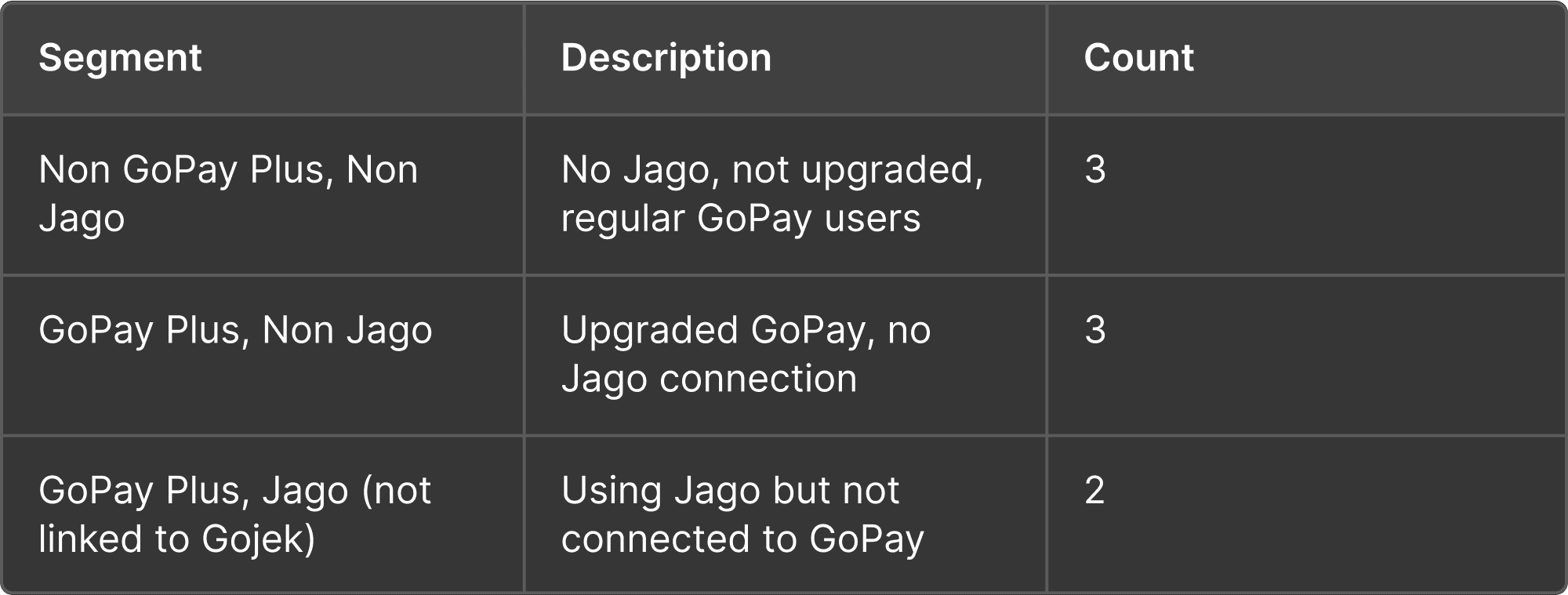
👥 Profile:
Ages 18–45
4 transactions per month in GoPay
Students, jobbers, homemakers, professionals
Mixed income segments
Area: Jabodetabek region(Jakarta)
📋 Research Results:
Users dropped during onboarding due to excessive steps (16)
Perceived the product as unfamiliar and “bank-like”
Wanted liquidity and reassurance
🧭 We Found some Clues in Other Markets but not exactly
While no directly comparable product exists in the Indonesian market, similar models in Southeast Asia point to a rising trend of smart wallet–bank integrations that blend spending and saving seamlessly.

DBS PayLah (Singapore)
Links e-wallet to DBS bank account
Auto-debit pulls funds when wallet balance is low
Enables seamless, invisible top-ups during payments

Touch ‘n Go Go+ (Malaysia)
Connects wallet to a money market Go+ account
Auto-debits Go+ if e-wallet balance is insufficient
Users earn passive returns while ensuring smooth transactions
🔁 Pivot: introducing GoPay Tabungan by jago
We reimagined the journey as a wallet upgrade, not a bank switch.
From 16 steps → 5-step onboarding, directly inside GoPay
From “Open a new account” → “Upgrade your GoPay Wallet”
This radically simplified entry into the product—and adoption soared.
A not so hidden problem of 72% population
About 72% of Indonesians support the implementation of sharia principles or want sharia law to be implemented in the country and the main USP of the feature was giving user benefit of interest and interest is haram in sharia principles.
🧪 3-Phase Rollout
MVP
Test pivot with 5-step in-wallet onboarding
→ Conversion 5× higher than legacy flowsPhase 1 – Non-Sharia Users
With interest, admin-free benefits, unlimited walletPhase 2 – Sharia Users
No interest, but same access and convenience for sharia users
🎯 User and Business goals

Reach 5M MTUs through native, low-friction adoption

Better payment reliability through reduced auth time, higher throughput SLOs, etc.

Improve KYC completion rate to 40% with zero-click onboarding.

Achieve 5x higher average balances than e-money users (~IDR 500K vs 100K).
MVp Launch & Post-MVP User Testing
❌ After launching the MVP, two key issues emerged:
Liquidity confusion:
Users still didn’t realize they could easily transfer money back to GoPay, making the product feel “locked.”
Liquidity confusion:
Users still didn’t realize they could easily transfer money back to GoPay, making the product feel “locked.”
Value perception gap:
Many users couldn’t understand how Tabungan was better than their existing GoPay Wallet.
✅ Our Fixes:
Added a “Transfer to GoPay” button directly on the dashboard
Introduced a side-by-side benefits comparison (inspired by Netflix’s plan table) to clearly show what users gain with Tabungan over Saldo(wallet)
OJK/LPS trust cues above the fold(to build trust)
After MVP UT we changed the onboarding page

And Finally!!
After various explorations and the initial beta versions, we embarked on a eight-month journey to refine our approach based on user feedback.


In action
📊 Results
👤 User Impact
38%
higher repeat transaction rate → Users stayed longer and transacted more often
IDR 520K
average user balance → Encouraged consistent micro-saving habits
5.2 Million
first-time savers onboarded in 3 months
93%
KYC completion up from 21%, after streamlining onboarding and linking it to wallet upgrade benefits.
💼 Business Impact
IDR 2.6 trillion
in total deposits
from 5.5M users
IDR 95 billion
saved annually
on promo budgets
42%
reduction in external bank transfer fees
85%
in-app transaction share → Improved ecosystem control and user lock-in
✅ Final Takeaway
GoPay Tabungan succeeded by reducing friction, building trust, and aligning incentives for users and the business.
A 16-step signup became a 5-tap upgrade.
A bank product became a wallet benefit.
That’s what made saving seamless.
What I've shown above is a very small fraction of the project. If you'd like to hear more about it, reach out to me at panwarnaveen29@outlook.com
Rewiring Habits: Shifting Indonesia from a Nation of Spenders to Savers
Problem: Jago Pockets saw low adoption due to a long 16-step onboarding, unclear benefits, and fears around money being locked. With a 21% conversion rate and 60% drop-off at the first screen, users didn’t see why they should switch from their existing GoPay Wallet.
Solution: We redesigned it as GoPay Tabungan—a 5-step wallet upgrade with clear, side-by-side benefit comparisons. Liquidity was made visible, onboarding simplified, and flows were tailored for Sharia and non-Sharia users. The new experience felt seamless and familiar, driving sharp adoption growth.
Company
Gojek
DELIVERABLES
Onboarding Optimization
Journey Design
Adoption Strategy
Year
2023
Role
End to End
product design
1.6 Million Accounts but out of 38 million, Still Not Enough
1.6 Million Accounts but out of 38 million, Still Not Enough
GoPay Wallet was a daily essential in Indonesia—but since it was just a wallet, users couldn’t earn interest, and GoTo couldn’t lend the money stored in it.
To fix this, we launched Jago Pockets (Jago bank account) registration inside the Gojek app in 2021.
→ Result: 1.6 million users opened bank accounts through the GoPay–Jago flow.
But even with strong marketing and product efforts, major drop-offs remained.
💼 As a Product Designer, I:
💼 As a Product Designer, I:
Led the re-architecture from Jago Pockets → GoPay Tabungan
Directed all research + post-MVP UT
Collaborated across PM, legal, Bank Jago, engineers
Shaped inclusive onboarding for Sharia and conventional segments
❌ Why the Original Flow Struggled
❌ Why the Original Flow Struggled
These issues, backed by funnel drop-off prioritization, made it clear. We needed a simpler, clearer, native experience.
Low conversion (~21%):
The Jago Pockets onboarding required 16 steps, including multiple forms, KYC redundancies, and mental effort. Users dropped off midway.
Weak value proposition:
60% drop-off on the first screen itself signaled users didn’t understand why they should open “another account.”
Unclear money fluidity:
Users feared their money would be locked once moved into Jago.(Like a Fixed Deposit lock-in period)
🧠 We conducted in-depth interviews & UT with 8 participants
Ages 18–45
4 transactions per month in GoPay
Students, jobbers, homemakers, professionals
Mixed income segments
Area: Jabodetabek region(Jakarta)
Users dropped during onboarding due to excessive steps (16)
Perceived the product as unfamiliar and “bank-like”
Wanted liquidity and reassurance
👥 Profile:
📋 Research Results:
🧭 We Found some Clues in Other Markets but not exactly
While no directly comparable product exists in the Indonesian market, similar models in Southeast Asia point to a rising trend of smart wallet–bank integrations that blend spending and saving seamlessly.
DBS PayLah (Singapore)
Links e-wallet to DBS bank account
Auto-debit pulls funds when wallet balance is low
Enables seamless, invisible top-ups during payments
Touch ‘n Go Go+ (Malaysia)
Connects wallet to a money market Go+ account
Auto-debits Go+ if e-wallet balance is insufficient
Users earn passive returns while ensuring smooth transactions
🔁 Pivot: introducing GoPay Tabungan by jago
We reimagined the journey as a wallet upgrade, not a bank switch.
From 16 steps → 5-step onboarding, directly inside GoPay
From “Open a new account” → “Upgrade your GoPay Wallet”
This radically simplified entry into the product—and adoption soared.
A not so hidden problem of 72% population
About 72% of Indonesians support the implementation of sharia principles or want sharia law to be implemented in the country and the main USP of the feature was giving user benefit of interest and interest is haram in sharia principles.
🧪 3-Phase Rollout
MVP
Test pivot with 5-step in-wallet onboarding→ Conversion 5× higher than legacy flowsPhase 1 – Non-Sharia Users
With interest, admin-free benefits, unlimited wallet
Phase 2 – Sharia Users
No interest, but same access and convenience for sharia users
🎯 User and Business goals
🎯 User and Business goals
Reach 5M MTUs through native, low-friction adoption
Better payment reliability through reduced auth time, higher throughput SLOs, etc.
Improve KYC completion rate to 40% with zero-click onboarding.
Achieve 5x higher average balances than e-money users (~IDR 500K vs 100K).
MVp Launch & Post-MVP User Testing
MVp Launch & Post-MVP User Testing
❌ After launching the MVP, two key issues emerged:
✅ Our Fixes:
Liquidity confusion:
Users still didn’t realize they could easily transfer money back to GoPay, making the product feel “locked.”
Value perception gap:
Many users couldn’t understand how Tabungan was better than their existing GoPay Wallet.
Added a “Transfer to GoPay” button directly on the dashboard
Introduced a side-by-side benefits comparison (inspired by Netflix’s plan table) to clearly show what users gain with Tabungan over Saldo(wallet)
OJK/LPS trust cues above the fold(to build trust)
After MVP UT we changed the onboarding page
And Finally!!
After various explorations and the initial beta versions, we embarked on a eight-month journey to refine our approach based on user feedback.
✅ Final Takeaway
✅ Final Takeaway
GoPay Tabungan succeeded by reducing friction, building trust, and aligning incentives for users and the business.
A 16-step signup became a 5-tap upgrade.
A bank product became a wallet benefit.
That’s what made saving seamless.
In action
What I've shown above is a very small fraction of the project. If you'd like to hear more about it, reach out to me at panwarnaveen29@outlook.com
📊 Results
38%
higher repeat transaction rate → Users stayed longer and transacted more often
520K
IDR average user balance → Encouraged consistent micro-saving habits
5.2 Million
first-time savers onboarded in 3 months
93%
KYC completion—up from 21%—after streamlining onboarding and linking it to wallet upgrade benefits.
👤 User Impact
💼 Business Impact