A 108× Jump: Fixing Lending From 0.5% to 54%
A 108× Jump: Fixing Lending From 0.5% to 54%
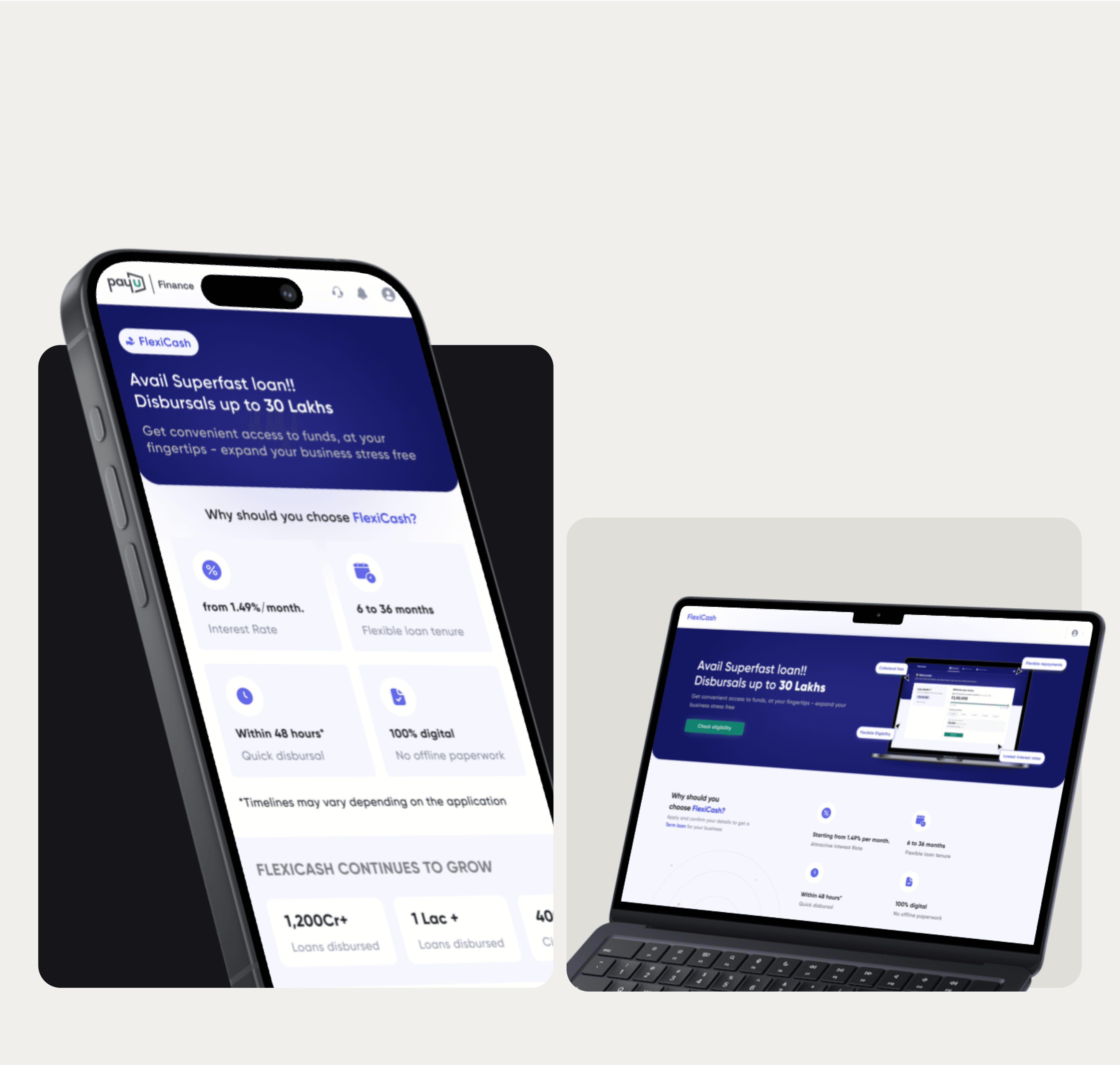
This case study revolves around redesigning FlexiCash, a business credit product that allows merchants to withdraw instant loans of up to ₹25 lakhs. The goal was to reimagine the product experience to match the company’s rapid growth while solving usability, performance, and trust issues.
Company
Payu finance
DELIVERABLES
Product Strategy
User Research
Product Design
Growth Enablement
Year
2025
Role
Design Lead
99.5% of Eligible Merchants Didn’t Onboard
FlexiCash is PayU’s B2B credit line for SMBs(Small and medium Businesses), offering instant loans up to ₹25 lakhs to partner and payment gateway merchants, based on their transaction history. Despite strong credit models and eligibility logic, the product struggled with activation: Only 0.5% of eligible merchants were completing onboarding.
We weren’t just facing a UX issue. We were facing a trust gap in a highly regulated, high-stakes journey.
And as a Design Lead
I owned the end-to-end product design for FlexiCash SMB:
Directed UX strategy and redefined the entire journey
Led and mentored 2 designers
Conducted primary research with 40+ merchants across Tier 1 and Tier 2 cities
Collaborated deeply with product, legal, engineering, and growth
Facilitated design reviews, rapid prototyping, usability tests, and rollout
My north star:
"Design an experience merchants would trust instantly, and understand without asking for help."
40 Conversations, 3 Sources, & 1 Clear Problem
Stakeholder Interviews
We conducted in-depth interviews with business, product, and engineering teams to align on KPIs such as improving conversion funnels, reducing drop-offs, and boosting disbursal and renewal rates.
User Research (Primary)
Interviewed 40 merchants (Tier 1 & 2 cities), split by PG and partner merchants (e.g., Swiggy, Meesho), and by sole vs non-sole proprietors, mostly aged 35+. Key issues included poor product visibility, broken multi-device flows, trust concerns with document sharing, confusion around repayment/onboarding, and inadequate support.
Competitive Analysis (Secondary)
Benchmarked Razorpay, Moneyview, and Open Money with detailed screen-by-screen and SWOT analysis to pinpoint FlexiCash’s gaps in features and onboarding.
Through 40+ user interviews and funnel data from Clevertap/Hotjar, we identified key issues:
Stakeholder Interviews
We conducted in-depth interviews with business, product, and engineering teams to align on KPIs such as improving conversion funnels, reducing drop-offs, and boosting disbursal and renewal rates.
User Research (Primary)
Interviewed 40 merchants (Tier 1 & 2 cities), split by PG and partner merchants (e.g., Swiggy, Meesho), and by sole vs non-sole proprietors, mostly aged 35+. Key issues included poor product visibility, broken multi-device flows, trust concerns with document sharing, confusion around repayment/onboarding, and inadequate support.
Competitive Analysis (Secondary)
Benchmarked Razorpay, Moneyview, and Open Money with detailed screen-by-screen and SWOT analysis to pinpoint FlexiCash’s gaps in features and onboarding.
Through 50+ user interviews and funnel data from Clevertap/Hotjar, we identified key issues:
🔻 73.9% drop-off at the very start of the journey (landing screen)
🔻 73.9% drop-off at the very start of the journey (landing screen)
📝 Only 0.66% completed MITC agreement signing
❌ Rage clicks and drop-offs on Aadhaar, KYC, and document upload steps
⚠️ The experience felt “too good to be true” due to legalese, generic UI, and unclear CTAs
The product was financially sound, but the experience lacked narrative, guidance, and reassurance.
How might we design a seamless, trustworthy, and intuitive lending experience that empowers merchants to easily discover, understand, and use instant credit, while reducing friction and building long-term engagement?
We Fixed Trust, KYC Friction, and Mobile Gaps

Build Clarity and Trust from Step One
Simplified MITC with expandable sections and inline support tips
Pre-onboarding education with eligibility logic, FAQs, and repayment visuals

Remove Friction Across Core Actions
Auto-filled KYC, guided document uploads, and repayment simulations
Clear “Withdraw Now” flow with contextual nudges

Make It Mobile & Merchant Friendly
Unified UI system across web and mobile
Optimized for small-screen merchants with progressive disclosure and clean hierarchy
Decided how the success will look like

More merchants complete onboarding and withdraw credit seamlessly.

Trust improves, leading to higher credit line renewals and usage.

Users need less support due to clear, guided flows.

Disbursal happens faster with reduced turnaround time.
Redesign Iterations
While testing the old dashboard, a merchant said,
"I see the numbers, but I don't know what to do next."
That’s when we realized: the problem wasn’t lack of data it was lack of guidance. The screen looked complete, but felt overwhelming. We didn’t need to show more; we needed to guide better.

Now we had the solution we were aiming for
After various explorations and the initial beta versions, we embarked on a six months journey to refine our approach based on user feedback.


Impact
UX metrics
54%
onboarding completion, up from just 0.5%
65%
MITC agreement acceptance, up from 0.66%
93%
Aadhaar and 91% KYC success rates, up from 22.9% and 16.3%
4.2/5
average user satisfaction, a significant post-launch increase
Business metrics
₹1,600 Cr
in loan originations enabled through the new experience.
₹1,150 Cr
in AUM, indicating strong product stickiness.
₹75 Cr
in gross margin and ₹30+ Cr in total profit achieved.
Key Takeaway
In lending, the first screen matters more than the last, because trust comes before usability. People don’t drop off because they’re confused; they drop off when they feel unsafe. Every word, icon, and visual signal must build credibility.
This wasn’t just a UX fix; it was a shift in philosophy:
From “Get them to claim” to “Help them understand and decide.”
We didn’t just show eligibility; we gave merchants the confidence to borrow.
And that made all the difference.
What I've shown above is a very small fraction of the project. If you'd like to hear more about it, reach out to me at panwarnaveen29@outlook.com
A 108× Jump: Fixing Lending From 0.5% to 54%
This case study revolves around redesigning FlexiCash, a business credit product that allows merchants to withdraw instant loans of up to ₹25 lakhs. The goal was to reimagine the product experience to match the company’s rapid growth while solving usability, performance, and trust issues.
Company
Payu finance
DELIVERABLES
Product Strategy
User Research
Product Design
Growth Enablement
Year
2025
Role
Design Lead
99.5% of Eligible Merchants Didn’t Onboard
99.5% of Eligible Merchants Didn’t Onboard
FlexiCash is PayU’s B2B credit line for SMBs(Small and medium Businesses), offering instant loans up to ₹25 lakhs to partner and payment gateway merchants, based on their transaction history. Despite strong credit models and eligibility logic, the product struggled with activation: Only 0.5% of eligible merchants were completing onboarding.
We weren’t just facing a UX issue. We were facing a trust gap in a highly regulated, high-stakes journey.
And as a Design Lead
And as a Design Lead
I owned the end-to-end product design for FlexiCash SMB:
Directed UX strategy and redefined the entire journey
Led and mentored 2 designers
Conducted primary research with 40+ merchants across Tier 1 and Tier 2 cities
Collaborated deeply with product, legal, engineering, and growth
Facilitated design reviews, rapid prototyping, usability tests, and rollout
My north star:
"Design an experience merchants would trust instantly, and understand without asking for help."
40 Conversations, 3 Sources, & 1 Clear Problem
Stakeholder Interviews
We conducted in-depth interviews with business, product, and engineering teams to align on KPIs such as improving conversion funnels, reducing drop-offs, and boosting disbursal and renewal rates.
User Research (Primary)
Interviewed 40 merchants (Tier 1 & 2 cities), split by PG and partner merchants (e.g., Swiggy, Meesho), and by sole vs non-sole proprietors, mostly aged 35+. Key issues included poor product visibility, broken multi-device flows, trust concerns with document sharing, confusion around repayment/onboarding, and inadequate support.
Competitive Analysis (Secondary)
Benchmarked Razorpay, Moneyview, and Open Money with detailed screen-by-screen and SWOT analysis to pinpoint FlexiCash’s gaps in features and onboarding.
Through 50+ user interviews and funnel data from Clevertap/Hotjar, we identified key issues:
🔻 73.9% drop-off at the very start of the journey (landing screen)
📝 Only 0.66% completed MITC agreement signing
❌ Rage clicks and drop-offs on Aadhaar, KYC, and document upload steps
⚠️ The experience felt “too good to be true” — due to legalese, generic UI, and unclear CTAs
How might we design a seamless, trustworthy, and intuitive lending experience that empowers merchants to easily discover, understand, and use instant credit while reducing friction and building long-term engagement?
We Fixed Trust, KYC Friction, and Mobile Gaps
Build Clarity and Trust from Step One:
Simplified MITC with expandable sections and inline support tips
Pre-onboarding education with eligibility logic, FAQs, and repayment visuals
Remove Friction Across Core Actions
Auto-filled KYC, guided document uploads, and repayment simulations
Clear “Withdraw Now” flow with contextual nudges
Make It Mobile & Merchant Friendly
Unified UI system across web and mobile
Optimized for small-screen merchants with progressive disclosure and clean hierarchy
Redesign Iterations
Redesign Iterations
While testing the old dashboard, a merchant said,
"I see the numbers, but I don't know what to do next."
That’s when we realized: the problem wasn’t lack of data it was lack of guidance. The screen looked complete, but felt overwhelming. We didn’t need to show more; we needed to guide better.
Decided how the success will look like
More merchants complete onboarding and withdraw credit seamlessly.
Trust improves, leading to higher credit line renewals and usage.
Users need less support due to clear, guided flows.
Disbursal happens faster with reduced turnaround time.
Now we had the solution we were aiming for
Now we had the solution we were aiming for
After various explorations and the initial beta versions, we embarked on a six months journey to refine our approach based on user feedback.
Key Takeaway
In lending, the first screen matters more than the last, because trust comes before usability. People don’t drop off because they’re confused; they drop off when they feel unsafe. Every word, icon, and visual signal must build credibility.
This wasn’t just a UX fix, it was a shift in philosophy:
From “Get them to claim” to “Help them understand and decide.”
We didn’t just show eligibility, we gave merchants the confidence to borrow.
And that made all the difference.
Outcomes
54%
onboarding completion, up from just 0.5%
65%
MITC agreement acceptance, up from 0.66%
93%
Aadhaar and 91% KYC success rates, up from 22.9% and 16.3%
4.2/5
average user satisfaction, a significant post-launch increase
₹1,600 Cr
in loan originations enabled through the new experience.
₹1,150 Cr
in AUM, indicating strong product stickiness.
₹75 Cr
in gross margin and ₹30+ Cr in total profit achieved.
Business metrics
UX metrics
What I've shown above is a very small fraction of the project. If you'd like to hear more about it, reach out to me at panwarnaveen29@outlook.com